
Guide
What is an AI Medical Scribe?
Short answer: an AI medical scribe is software that listens to a clinical encounter, transcribes the conversation, and generates structured notes — SOAP, consult, referral, or custom templates — that the clinician reviews and signs into the EMR. Long answer below, with the trade-offs vendors don't always volunteer.
The 60-second definition
An AI medical scribe is a clinical documentation tool that uses speech-to-text plus large language models to (1) capture a visit, (2) draft a chart-ready note, and (3) hand off to the clinician for review. The clinician remains the author of record — the AI handles the typing.
Three forms exist today: ambient (mic listens to the full visit, draft generated after), dictation-style (clinician narrates the note explicitly), and asynchronous (upload a recording later). Most modern tools support all three modes.
What it replaces (and what it doesn't)
Replaces: end-of-day charting backlog, manual typing, human in-person scribes that cost $31,000-$42,000/year (PayScale 2024). The AMA's 2024 burnout report ties documentation burden to 60%+ of physician burnout cases — that's the gap AI scribes target.
Does NOT replace: clinical judgment, the chart review step, billing code finalization (the AI suggests, the clinician verifies), or the patient consent conversation (CPSO, CMPA, and most US state boards require patient consent before recording).
How it works under the hood
Audio is captured by mic and streamed to a cloud transcription model (typically running on Azure, AWS, or GCP infrastructure with healthcare BAAs). Transcripts feed into a clinical LLM trained for medical terminology, which structures the output into the specified note format (SOAP, consult letter, etc.).
Privacy-first tools (like Scribeberry) stream audio without persisting it — only the transcript and generated note are retained, and even those can be deleted on demand. Per-region data residency means Canadian patient data stays in Canadian data centers; US data stays in US.
Who actually uses it
Solo and group physicians (family medicine, internal medicine, psychiatry — the highest-documentation specialties). Nurse practitioners and physician associates. Dentists and veterinarians (yes, same model architecture). Increasingly, enterprise health systems are rolling AI scribes out to all providers (The Permanente Medical Group reported 7,260 physicians using ambient AI scribes in NEJM Catalyst, 2025).
Adoption is heaviest in primary care (where documentation per visit is highest per dollar of revenue) and psychiatry (where 45-90 minute sessions generate disproportionate after-hours charting).
Cost in 2026
Per-provider AI scribe pricing now clusters at $99/month for the mid-market and $200-$300+/month for enterprise tools. Free tiers exist (Scribeberry, Heidi). Most vendors offer 30-day trials. See /guides/ai-scribe-cost for the full breakdown.
Compared to a human scribe ($31K-$42K/year per provider), AI scribes typically pay back in under 60 days at $99/month.
What to look for when evaluating
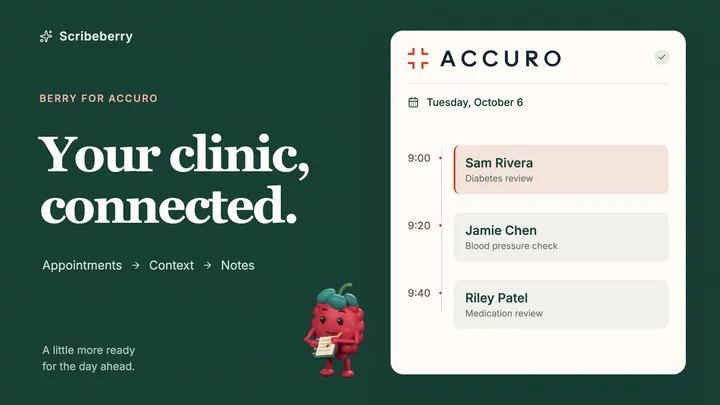
EMR fit (Accuro, Oscar, Jane, Epic, Cerner — whichever you use). Compliance match (HIPAA for US, PIPEDA for Canada, plus provincial like PHIPA/PIPA/Law 25). Specialty templates that actually match your note style. Transparent pricing. A real free trial.
Skip: vendors that require a sales call to see pricing, tools that don't integrate with your EMR, or any product that won't sign a BAA.
Frequently asked questions
Is an AI medical scribe accurate?
Modern AI medical scribes claim 95-99.9% transcription accuracy and produce review-ready clinical notes. The clinician still reviews and signs every note — the AI drafts, the clinician confirms. Accuracy varies more by specialty than by vendor; ambient capture in noisy environments is harder than dictation.
Is it HIPAA compliant?
Reputable AI medical scribes are HIPAA compliant and will sign a Business Associate Agreement (BAA). Scribeberry is HIPAA, PIPEDA, and SOC 2 Type 2 certified. Always verify compliance documentation before deploying any AI tool in clinical workflows.
Do patients need to consent to being recorded?
Yes. Most jurisdictions require patient consent before audio recording during a clinical encounter. CPSO, CMPA, and most US state medical boards have explicit guidance. Scribeberry includes a consent-first workflow and provides a patient informed consent form template.
What happens to the audio recording?
Privacy-first AI scribes (including Scribeberry) stream audio in real-time without persistent storage — only the transcript and the final note are retained. Some legacy products do store audio; always check the vendor's data retention policy.
Will the AI scribe replace human medical scribes?
For most outpatient settings, yes — economics favor AI at $99/month vs $31K-$42K/year per provider for a human scribe. Human scribes still have a role in complex emergency, surgical, and inpatient settings where workflow integration matters more than cost.
Evaluate Scribeberry
Related pages
Keep reading
More guides
Recent blog posts
Latest blog posts on AI medical scribes, clinical documentation, and practical workflows.