

Guide
Dental practice management software
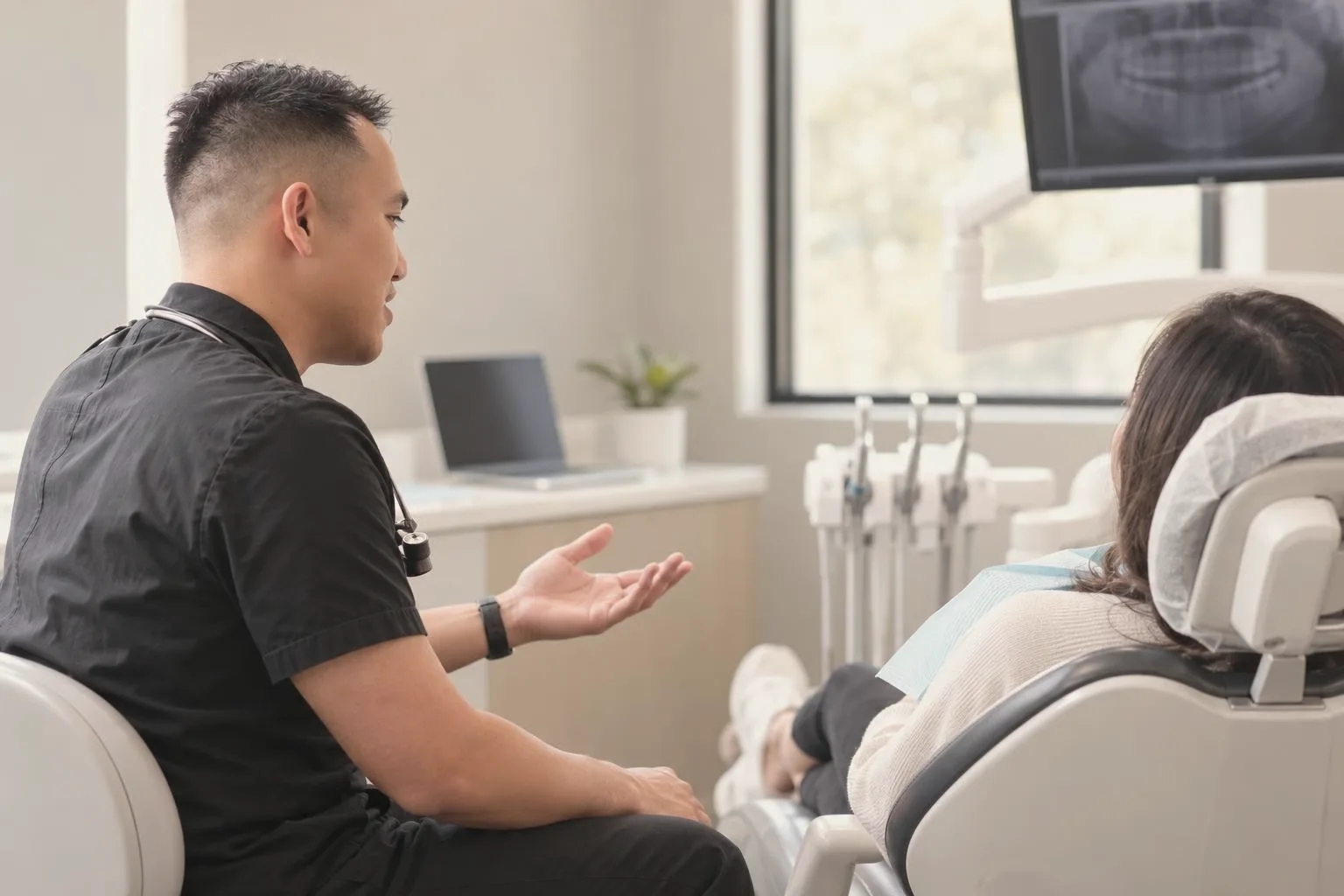
A dental practice management system (PMS) is the clinic's operations plus the odontogram: schedule, claims, charting of surfaces and perio, imaging links, and recall. It is not a medical EMR with extra tooth numbers glued on. This page explains how dental clinics actually chart and where an AI scribe can sit. It is not a ranking of vendors and it is not a Gartner-style quadrant.
Dental practice management software
Recording- Subjective
- Objective
- Assessment
- Plan
Key takeaways
- A dental practice management system (PMS) is the clinic's operations plus the odontogram: schedule, claims, charting of surfaces and perio, imaging links, and recall.
- This guide is written for Canadian practice: provincial privacy law, regulator expectations, and real EMR workflow are addressed directly rather than adapted from US guidance.
- Before signing or filing, check four things: explicit reason for the encounter, negatives that change management, consent for any disclosure, and a follow-up owner with a date.
What a dental PMS holds
Medical EMRs think in problems and visits. Dental PMS products think in teeth, surfaces, procedures, and insurance estimates. The same patient can have a hygiene visit, a restorative appointment, and an endo start as separate scheduled units with different providers and different claim codes. Imaging (sensors, panoramics, CBCT) usually lives in a linked viewer, not in the narrative note. If you only look at the clinical note pane, you miss where the work actually is.
| Module | Job | Scribe relevance |
|---|---|---|
| Schedule / operatory | Chairs, providers, recalls | Which encounter you are documenting |
| Odontogram / perio | Existing restorations, planned work, probing | Usually clicked, not dictated as a novel |
| Narrative / SOAP-like notes | Medical history, consent, what was done today | This is where ambient or dictation helps |
| Imaging | Bitewings, PA, pano, CBCT | Scribe does not read the radiograph for you |
| Claims / COB | Dental procedure codes, predeterminations, two plans | Note must match the procedure billed |
Canadian dental offices may run AbelDent, Dentrix (various editions), Tracker, ClearDent, Oscar Dental in some sites, Jane in allied-heavy clinics, or other regional products. US offices often run Dentrix, Eaglesoft, Open Dental, or cloud suites. Names change with acquisitions. Confirm what is on the operatory PC rather than buying a scribe 'integration' for a product you retired.
Charting vs narrative
Surface charting (MO composite on 26) belongs in the odontogram because claims and future dentists read it there. The narrative is for the history (INR, pregnancy, bisphosphonates), the consent conversation, the local anaesthetic, pulp tests, what the patient was told about a cracked cusp, and the follow-up. Mixing a 12-surface chart into a prose paragraph makes both worse.
- Medical history updates belong in a real note, especially antibiotics, joint replacements, and cardiac questions.
- Hygiene notes: bleeding, home care, what you showed the patient. Not only 'prophy done.'
- Surgical / extraction: consent, tooth, anaesthesia, complications, post-op instructions given.
- Ortho and peds: who consented, behaviour, and what the parent heard.
Not a software bake-off
This page will not score vendors on 'vision' or 'completeness of vision.' Pick a PMS for imaging bridges, lab connectors, and the claims network you actually use. Then decide whether a scribe belongs next to it.
Who runs dental practice software, and when it matters
Dental teams use practice-management software for charting, imaging, scheduling, recall, and insurance (including CDCP) claims. The choice shapes hygienist workflow, odontogram accuracy, and how painless billing feels at month-end.
- New dental practices choosing a first platform.
- Clinics digitizing paper charts and film imaging.
- Multi-site groups standardizing operations.
- Practices adding online booking and AI documentation.
Documentation, privacy, and record-keeping in Canada
Clinical notes and forms form part of the legal medical record in Canada. Provincial regulators expect entries that are contemporaneous, factual, attributable, and legible; health information is handled under provincial privacy law (such as PHIPA in Ontario, the HIA in Alberta, and Law 25 in Quebec) and PIPEDA where it applies. Disclose the minimum necessary, with patient consent, and record amendments as amendments — never by overwriting the original entry.
For dental practice management software, that standard is practical, not abstract: dates and times that can be reconstructed, negatives that change management recorded explicitly, consent documented wherever information leaves the circle of care, and a named follow-up owner with a date. If a reviewer, a receiving clinician, or a college investigator cannot rebuild what happened from the record alone, the record is not finished.
Common mistakes to avoid
- Charting migration that loses odontogram history.
- Insurance and CDCP claim rules configured incorrectly at setup.
- Recall systems that quietly stop contacting patients.
- Imaging tied to proprietary formats with no export.
- Choosing on price while hygiene workflow gets slower.
The signing checklist
Before signing: Is the reason for the encounter explicit? Are negatives that change management recorded? Does every problem have a plan with an owner and a date? Are results, counselling, consent, and follow-up documented — or only intended?
Where an AI scribe fits
Dentists and hygienists talk throughout a visit with a mask on and a suction running. Ambient capture is harder than a family-medicine exam room. Dictation between patients, or a short recap after the patient leaves the chair, is often the better input. The output should be the narrative and the medical-history update, which you paste or push into the PMS note field. It should not try to click your odontogram.
- Consent to record in an open bay is different from a closed medical office. Many clinics will not record ambient audio on the floor. Dictation in a private office is easier to defend.
- PHI still applies. Provincial health privacy and PIPEDA (and HIPAA if you treat US patients) do not stop at medicine.
- Claims: the narrative should support the procedure codes you submit. Do not let a draft invent a crown prep you did not start.
- COB: two dental plans are common. That stays in the PMS insurance tab.
Scribeberry can draft dental visit narratives and medical-history updates from dictation or, where the clinic allows, a consented recording. You still chart teeth in the PMS and you still sign. Test the paste or extension path on your actual dental software; do not assume a medical Accuro button exists on a Dentrix terminal.
Narrative notes beside the odontogram
Scribeberry drafts the words; your PMS keeps teeth, images, and claims. Review, paste or push, sign. Pro is $99/month after the free trial.
Frequently asked questions
The system a dental clinic uses to schedule, chart teeth and perio, store or link imaging, and submit insurance claims. It is built around procedures and the odontogram, not only visit notes.
No. Some products overlap, and some clinics use Jane or a medical EMR for notes, but tooth-level charting and dental claims are a different job.
Treat odontogram clicks as the dentist's or hygienist's job. Use a scribe for narrative, history, and consent language, then transfer that text into the PMS.
No. It sits beside the PMS as a documentation draft. Imaging and claims stay in the dental software.
Start with your provincial regulator's documentation standard and privacy legislation (for example CPSO and PHIPA in Ontario), CMPA guidance on record keeping, and Canada Health Infoway for digital-health and interoperability direction. Rules cited on this page are summarized in the References section.
Assign an owner, document consent and disclosure, keep the record contemporaneous, and review the workflow against your provincial standard before rollout. Pilot with one team, audit a sample of records, then scale what survives contact with a real clinic day.
References
- Good practices in medical record keeping — Canadian Medical Protective Association (CMPA)
- Medical Records Documentation — practice standard — College of Physicians and Surgeons of Ontario (CPSO)
- Personal Health Information Protection Act (PHIPA) — Government of Ontario
- Digital health in Canada — Canada Health Infoway
- Canadian Dental Association — CDA
Examples on this page are fictional and for illustration only; they do not describe real patients. Templates reflect the corresponding built-in template in Scribeberry at the date above.

