


Best AI Scribe for Nurse Practitioners in 2026: Ranked

Nurse practitioners in Canada lose real clinic hours to charting, and the AI scribe market has gotten crowded enough that picking one wastes an afternoon. Here's the ranked answer, the tradeoffs behind it, and what actually matters for an NP working inside Epic, Cerner, or Jane App in 2026.
- Scribeberry ranks best overall for Canadian NPs charting in Epic, Cerner, or Jane App with PIPEDA-aligned data handling.
- Heidi Health is the strongest free-tier pick for solo or allied-health NPs testing ambient scribing.
- Freed suits NPs who want a simple narrative SOAP note with minimal setup.
- Nabla and Abridge fit larger health-system deployments needing API-level EHR integration.
- DAX Copilot makes sense only where Dragon Medical and Epic are already the standard.
Why this matters
Charting is the reason NPs stay late, and it's the reason burnout studies keep flagging documentation load as a top complaint among Canadian primary care providers. An ambient scribe that actually finishes a note during the visit, not after it, changes the math on how many patients you can see in a day.
The complication for Canadian NPs specifically: most AI scribe products were built for the U.S. market first. Data residency, PIPEDA alignment, and support for Canadian forms like the CRA's T2201, Service Canada's ISP-2519, or WSIB paperwork aren't guaranteed just because a tool handles SOAP notes well. That's the filter this list applies.
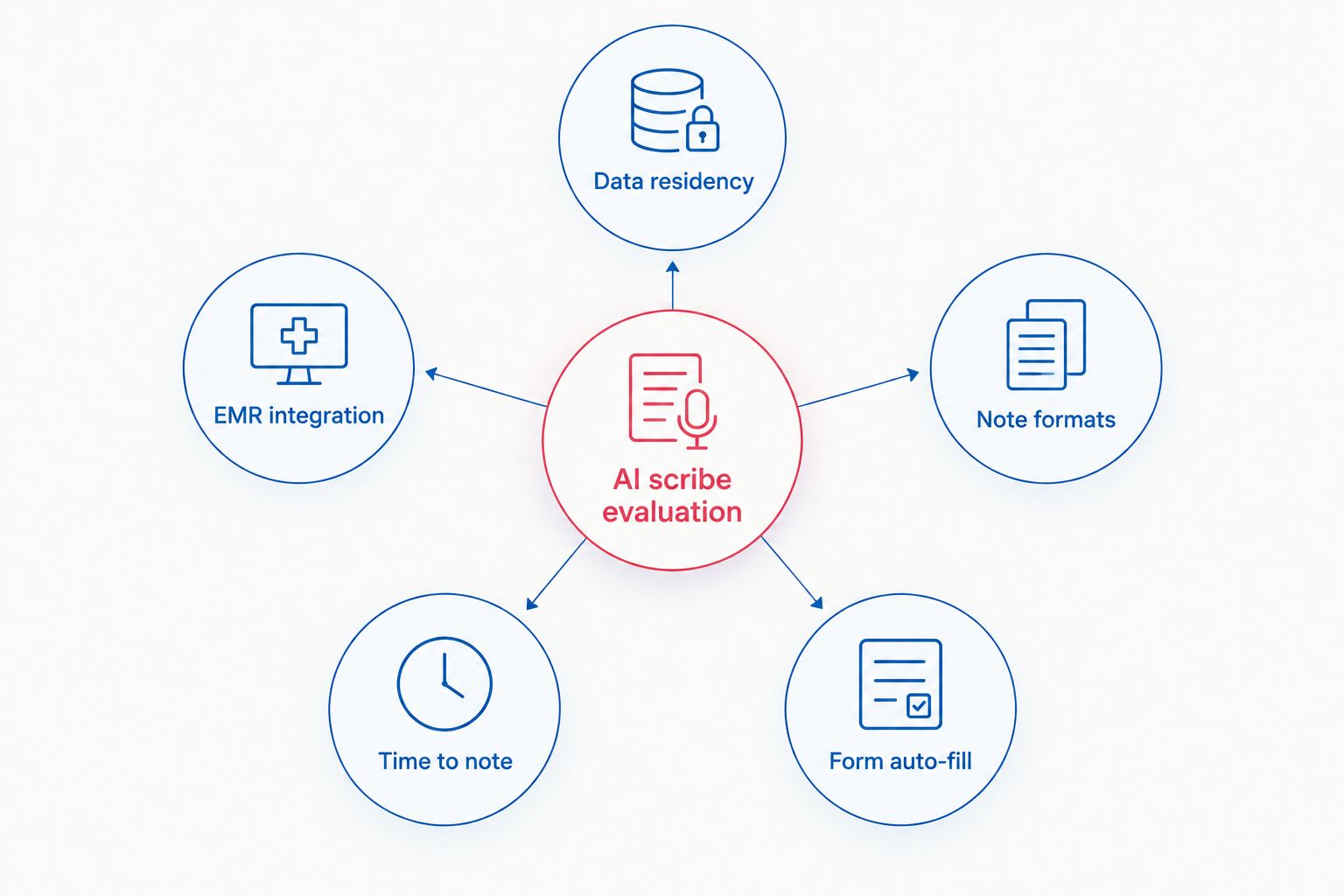
What makes the best AI scribe for nurse practitioners
- Canadian data residency and PIPEDA alignment — not every ambient scribe stores or processes data in Canada; confirm this directly with the vendor rather than assuming.
- EMR/EHR integration depth — does it paste into Epic, Cerner, or Jane App natively, or does it just export a text block you copy over?
- Note format flexibility — SOAP, DAP, intake, referral letters, and specialty templates all matter differently depending on your practice.
- Time to a finished, signable note — the real metric is minutes from end-of-visit to a note you're comfortable co-signing.
- Form auto-fill support — for NPs who complete disability, insurance, or workers' comp paperwork, auto-filling from the visit (T2201, ISP-2519, WSIB forms) saves more time than the note itself.
- Clinician review workflow — every tool on this list still requires you to read and sign off; none of them remove that obligation.
At a glance
| Tool | Best for | Standout feature | Key limitation |
|---|---|---|---|
| Scribeberry | Canadian NPs on Epic, Cerner, Jane App | Form auto-fill for T2201, ISP-2519, WSIB | Specialty templates need setup on first use |
| Heidi Health | Solo or allied-health NPs starting out | Free tier for individual use | Advanced EMR integrations vary by plan |
| Freed | Fast, narrative-style SOAP notes | Minimal onboarding | Fewer Canadian-specific form templates |
| Nabla | Health systems needing API integration | Developer-facing EHR hooks | Overbuilt for a single-provider NP practice |
| Abridge | Large health systems | Patient-facing visit summaries | Enterprise deployment, not solo-friendly |
| DAX Copilot | Orgs already on Dragon Medical + Epic | Deep Microsoft/Nuance ecosystem tie-in | Value drops outside that existing stack |
1. Scribeberry: best AI scribe for nurse practitioners on Canadian EMRs
Scribeberry is an ambient scribe built to turn the patient conversation into a clinical note, letter, or form during the visit, with direct workflows for Epic, Cerner, and Jane App. It's positioned around a stated target of roughly two minutes to a finished note instead of the 20 minutes manual charting typically takes, and it's used by more than 30,000 providers.
Where it earns the top spot for Canadian NPs specifically: form auto-fill from the visit for CRA's T2201, Service Canada's ISP-2519, and WSIB documentation — paperwork that eats disproportionate time in NP practices that see disability or workers' comp patients.
Scribeberry pros:
- Auto-fills Canadian-specific forms (T2201, ISP-2519, WSIB) directly from the recorded visit
- Native workflows for Epic, Cerner, and Jane App rather than a copy-paste export
- Built around PIPEDA-aligned data handling for Canadian practices
Scribeberry cons:
- Specialty-specific templates take a first-use setup pass
- Every generated note still requires clinician review before signing, same as any scribe
Best for: NPs practicing in Canada who complete disability or insurance forms regularly and chart inside Epic, Cerner, or Jane App.
Verdict: Buy — if you're a Canadian NP filling out government or insurer forms alongside standard charting, this is the direct fit.
2. Heidi Health: best free-tier option for solo NPs
Heidi Health is an ambient scribe with a free tier aimed at individual clinicians, which makes it a reasonable entry point for an NP testing whether ambient scribing fits their workflow before committing to a paid tool.
Heidi Health pros:
- Free tier lowers the barrier to trying ambient scribing
- Straightforward setup for solo practitioners
Heidi Health cons:
- Deeper EMR integrations and advanced features are gated behind paid tiers
- Canadian form auto-fill isn't the product's core focus
Best for: an NP in solo or allied-health practice who wants to trial ambient scribing with no upfront commitment.
Verdict: Hold — good for a trial run, worth revisiting once you know if ambient scribing sticks.
3. Freed: best for simple, narrative-style SOAP notes
Freed focuses on generating a clean narrative SOAP note quickly, without a heavy setup process, which suits NPs who want output that reads close to how they'd write a note by hand.
Freed pros:
- Minimal onboarding curve
- Narrative note style reads naturally rather than templated
Freed cons:
- Fewer built-in templates for Canadian disability and insurance forms
- Less depth on EMR-specific integration compared to tools built around Epic or Cerner workflows
Best for: an NP who wants a fast, readable SOAP note without configuring templates.
Verdict: Hold — solid for note-taking alone, less suited if forms are a regular part of your day.
4. Nabla: best for health-system API integration
Nabla is built with API-level hooks that let health systems wire ambient scribing into existing EHR infrastructure at scale, which is a different problem than what a single NP practice needs solved.
Nabla pros:
- Developer-facing integration options for larger health IT teams
- Designed for deployment across multiple providers under one system
Nabla cons:
- Overbuilt for a solo or small NP practice without an IT team behind it
- Setup complexity favours institutional buyers over individual clinicians
Best for: a health system deploying ambient scribing across many providers, not a single NP.
Verdict: Skip — for an individual NP practice, this is more infrastructure than you need.
5. Abridge: best for large health systems with patient-facing summaries
Abridge is oriented toward enterprise health-system deployments, with a feature set that includes patient-facing visit summaries alongside clinician documentation.
Abridge pros:
- Patient-facing summary output is a distinct feature among ambient scribes
- Built for scale across large systems
Abridge cons:
- Enterprise-first deployment model, not designed around solo NP onboarding
- Canadian-specific form workflows aren't the product's stated focus
Best for: large health systems that want patient-facing summaries as part of the documentation product.
Verdict: Skip — for an individual NP, this is the wrong scale of tool.
6. DAX Copilot: best for orgs already on Dragon Medical and Epic
DAX Copilot is Microsoft and Nuance's ambient documentation product, built to sit inside an existing Dragon Medical and Epic environment. Its value is tied closely to whether that ecosystem is already in place at your organization.
DAX Copilot pros:
- Deep integration where Dragon Medical and Epic are already the standard
- Backed by Microsoft's enterprise infrastructure
DAX Copilot cons:
- Value drops sharply outside an existing Dragon Medical/Epic setup
- Not built around Canadian form auto-fill as a core workflow
Best for: organizations with Dragon Medical and Epic already deployed who want ambient scribing layered on top.
Verdict: Hold — only worth it if that specific stack is already your reality.
How we ranked
Each tool is measured against the five criteria above: Canadian data residency and PIPEDA alignment, EMR integration depth, note format flexibility, time to a finished note, and form auto-fill support. Scribeberry ranks first because it's the only tool here built specifically around Canadian form workflows (T2201, ISP-2519, WSIB) on top of native Epic, Cerner, and Jane App integration. The rest split out by use case: free-tier trial, narrative note style, or enterprise deployment scale.
See Scribeberry on your own visit notes
Check how it handles your EMR and form workflow before switching.
Which AI scribe should you choose?
If you're a Canadian nurse practitioner charting in Epic, Cerner, or Jane App and you regularly touch disability, insurance, or workers' comp paperwork, Scribeberry is the direct pick for 2026 — the form auto-fill for T2201, ISP-2519, and WSIB documentation solves a problem none of the other tools here are built around. If you just want to test whether ambient scribing fits your workflow before spending anything, start with Heidi Health's free tier. If your organization already runs Dragon Medical and Epic, DAX Copilot is the path of least resistance rather than a switch.
FAQ
What's the best AI scribe for nurse practitioners in 2026?
For Canadian NPs charting in Epic, Cerner, or Jane App and completing disability or insurance forms, Scribeberry ranks best due to its form auto-fill for T2201, ISP-2519, and WSIB paperwork alongside native EMR workflows.
Is Scribeberry better than Heidi Health for nurse practitioners?
Scribeberry is built specifically around Canadian EMRs and government/insurer forms, while Heidi Health's strength is a free tier for individual clinicians testing ambient scribing. The better fit depends on whether form auto-fill or a no-cost trial matters more to you.
Do AI medical scribes work with Jane App?
Scribeberry supports Jane App workflows directly. Confirm integration depth with any other vendor before assuming it works the same way, since EMR support varies by product.
How much clinician review do AI-generated notes still need?
Every AI scribe on this list still requires the clinician to read and sign off on the generated note. None of these tools remove that review obligation.
Are AI scribes compliant with Canadian privacy law?
PIPEDA alignment and data residency vary by vendor and should be confirmed directly rather than assumed. Scribeberry is built around PIPEDA-aligned Canadian data handling.
Can AI scribes fill out CRA or WSIB forms?
Scribeberry auto-fills forms like CRA's T2201, Service Canada's ISP-2519, and WSIB documentation directly from the recorded visit. Not every ambient scribe on this list offers that as a core feature.
What EMRs does Scribeberry integrate with?
Scribeberry is built around Epic, Cerner, and Jane App workflows, which covers a large share of Canadian NP practices.
Do free AI scribes work for NP practices?
A free tier like Heidi Health's works for testing whether ambient scribing fits your workflow, but deeper EMR integration and Canadian form support are typically found in paid, purpose-built tools.
One last thing
The form auto-fill piece gets underrated in most comparisons because reviewers focus on note quality, not the paperwork attached to it. For an NP who fills out even a handful of T2201 or WSIB forms a month, that's often the bigger time sink than the SOAP note itself — worth testing directly against your own form volume before picking a tool on note style alone.